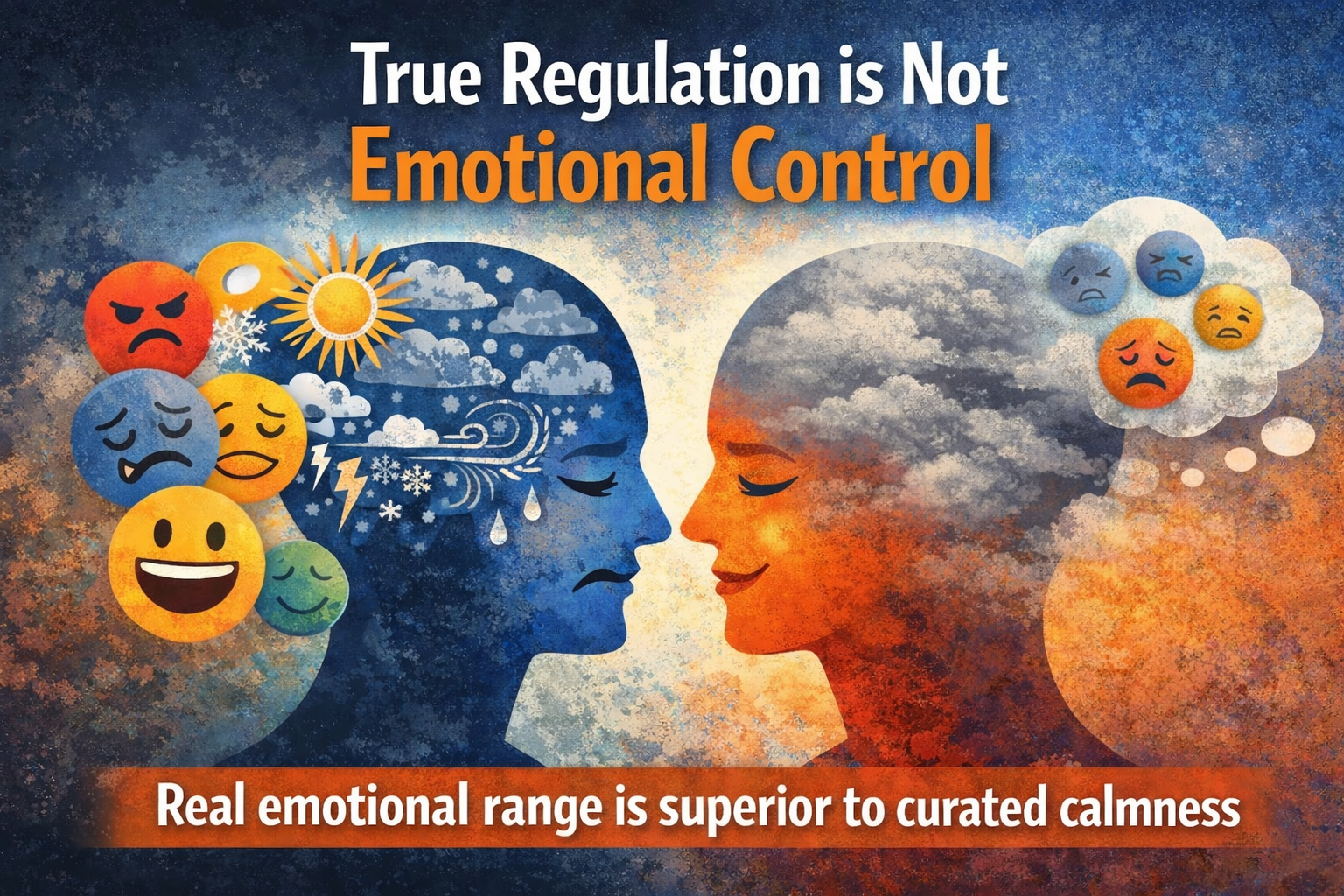
The Myth of Emotional Control
In modern therapeutic and self-help culture, regulation is often equated with emotional restraint. The regulated person is imagined as calm, steady, measured, and unreactive. This image is appealing, especially in a world that feels increasingly chaotic. But it is also misleading.
Emotional control is not the same thing as regulation.
Control is about reducing expression. Regulation is about increasing capacity.
A person can be quiet, polite, reasonable, and calm while being profoundly dysregulated internally. Conversely, a person can be expressive, intense, grieving, or angry while remaining deeply regulated. The nervous system does not measure health by volume. It measures health by coherence.
To understand regulation properly, we need to move away from surface affect and toward functional criteria.
Apparent Regulation: When Calm Is Actually Freeze
Many behaviors that are socially rewarded as maturity are, in fact, defensive states. They help the system avoid overload, but they do not resolve it.
Common examples include:
Emotional detachment. The person feels little because they have learned not to feel. This is not peace; it is withdrawal.
Intellectualization. Experience is translated into concepts before it can be felt. Insight replaces contact.
Spiritual bypassing. Language about acceptance, transcendence, or compassion is used to skip anger, grief, or desire.
Hyper-reasonableness. The person stays logical and fair at the cost of their own signal.
Over-tolerance. Enduring more than is healthy while calling it strength.
Boundary talk without enforcement. Limits are articulated but never acted on.
Self-sufficiency as identity. Needing nothing becomes a badge of honor.
These states often feel controlled and composed. But they are rigid. They reduce movement. And they typically collapse under sustained pressure.
From the outside, the person appears regulated. From the inside, they are often bracing.
True Regulation: Capacity Over Control
True regulation is not defined by how little emotion is shown, but by how much experience the system can hold without fragmenting.
A regulated nervous system can:
- Feel strong emotion without becoming flooded
- Act without being hijacked by impulse
- Set limits without aggression or collapse
- Stay present in uncertainty
- Disengage cleanly when necessary
This means that true regulation often looks less controlled, not more.
Consider anger. Unregulated anger is explosive, blaming, or punitive. But regulated anger is clear, contained, and protective. It says, “This is not acceptable,” and then it moves the person toward action.
Consider frustration. Unregulated frustration snaps into aggression or withdrawal. Regulated frustration recognizes limits, expresses them clearly, and moves forward without lingering tension.
Consider jealousy. Unregulated jealousy spirals into suspicion, blame, or control. Regulated jealousy is acknowledged as a signal, allowing the person to reflect, communicate clearly, and act from grounded choice rather than compulsion.
Consider grief. Unregulated grief overwhelms and immobilizes. Regulated grief hurts, but it flows. It allows mourning without identity collapse.
Consider desire. Unregulated desire becomes compulsive, entitled, or manipulative. Regulated desire can be strong, even urgent, while remaining choiceful.
Consider fear. Unregulated fear leads to panic, avoidance, or freezing. Regulated fear notices risk without being paralyzed, allowing cautious assessment and deliberate action.
Consider anxiety. Unregulated anxiety hijacks attention, creating rumination or avoidance. Regulated anxiety is noticed and contained, guiding reflection and deliberate response rather than reactive overwhelm.
Consider shame. Unregulated shame triggers withdrawal, self-attack, or projection onto others. Regulated shame is felt, owned, and processed without collapsing the self, often guiding reflection or growth.
Consider longing. Unregulated longing becomes clinging or dependent. Regulated longing allows for desire and connection while maintaining autonomy and balance.
In each case, regulation is revealed by coherence, not suppression. True regulation holds the full range of experience without being dominated by it—it shows strength through presence, not restraint.
Three Criteria for True Regulation
Rather than asking whether someone looks calm, it is more useful to assess regulation using three criteria: mobility, contact, and choice.
1. Mobility
Is the person able to move toward or away from a situation?
A regulated system can engage, disengage, pause, or change direction. A dysregulated system gets stuck—either clinging or avoiding.
Mobility shows up in simple ways: the ability to leave a conversation without drama, to pursue something without obsession, or to stop when something becomes unhealthy.
2. Contact
Is the person in relationship with reality?
True regulation maintains contact with what is actually happening, internally and externally. False regulation often manages distance through numbness, analysis, or control.
Contact means being affected without being overtaken.
3. Choice
Is the behavior selected, or forced by discomfort?
When behavior is driven primarily by the need to reduce anxiety, avoid pain, or restore equilibrium, choice is compromised. Regulation restores choice.
A regulated person may still feel urgency, but they are not compelled.
Examples in Real Life
Workplace example: A manager calmly absorbs excessive workload, never complains, and never says no. They appear regulated. In reality, they are frozen. A regulated alternative might involve frustration, a difficult conversation, and a firm boundary.
Relationship example: Someone remains emotionally neutral after a betrayal, insisting they are fine. Months later, resentment leaks out sideways. This was not regulation. Regulation would involve anger, grief, and possibly separation, expressed cleanly.
Leadership example: A leader who tolerates chronic dysfunction to avoid conflict may look stable. A regulated leader may confront issues directly, creating temporary discomfort but long-term coherence.
Secure Attachment and the Trap of Over-Control
Secure and earned-secure individuals are particularly vulnerable to mistaking control for regulation. Because they can tolerate a great deal, they may overfunction, over-accommodate, or over-stabilize.
This phase often looks like being “the strong one.” But strength without limits eventually becomes self-erasing.
Graduation occurs when the system learns that regulation does not require constant containment. Calm becomes optional. Intensity becomes survivable. Limits become embodied rather than defended.
Conclusion
Regulation is not about being unbothered. It is about being available.
Not about emotional suppression, but emotional capacity.
Not about control, but coherence.
When regulation is understood this way, it stops being a performance and becomes a foundation. The person no longer needs to look calm. They simply remain themselves, even when things matter.