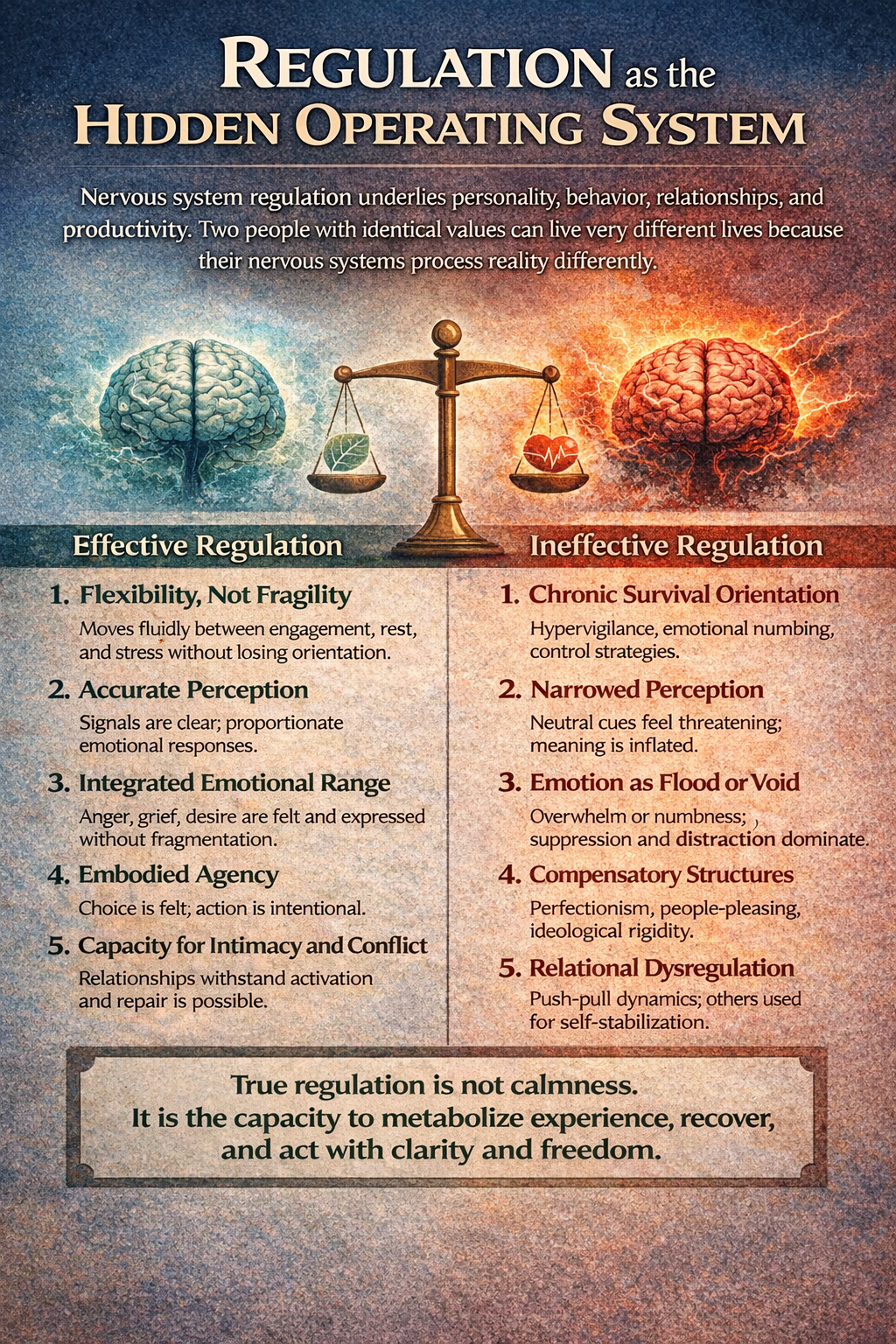
Nervous System Regulation as the Hidden Operating System
Nervous system regulation is the unseen infrastructure beneath personality, behavior, relationships, productivity, and even ideology. Two people can hold identical values, skills, and intentions yet live radically different lives because their nervous systems process reality differently.
When regulation is effective, life feels navigable—even when difficult. When regulation is ineffective, life feels adversarial—even when objectively stable. This is not a moral distinction. It is a biological and developmental one.
The contrast between effective and ineffective regulation is best understood not as a spectrum of calmness, but as a difference in how experience is metabolized.
Paradigm One: Effective Nervous System Regulation
1. Flexibility, Not Fragility
An effectively regulated nervous system is flexible. It can move fluidly between states—engagement, rest, mobilization, intimacy—without getting stuck. Stress activates the system, but does not overwhelm it. The person remains oriented in time, place, and self.
This flexibility allows for:
- Rapid recovery after stress
- Emotional expression without loss of agency
- Adaptive problem-solving under pressure
Crucially, effective regulation does not eliminate stress responses—it uses them.
2. Accurate Perception
Regulation shapes perception. When the nervous system is stable, the brain can discriminate between signal and noise. A raised voice is just a raised voice—not proof of danger, rejection, or impending collapse.
This allows:
- Proportional emotional responses
- Reduced projection onto others
- Greater tolerance for ambiguity
The world appears more nuanced, less threatening, and more workable.
3. Integrated Emotional Range
Effective regulation allows the full emotional spectrum without fragmentation. Anger can arise without turning into aggression. Sadness can be felt without becoming despair. Desire can be expressed without compulsion or shame.
Emotion becomes information, not a command.
This integration supports:
- Clean boundaries
- Authentic expression
- Healthy assertion and receptivity
4. Embodied Agency
A regulated system experiences itself as an actor, not a reactor. There is a felt sense of choice even in difficult moments. The person can pause, feel, decide, and act.
This embodied agency is the foundation of:
- Leadership
- Secure attachment
- Moral responsibility
It is not confidence as bravado—it is confidence as grounded presence.
5. Capacity for Intimacy and Conflict
Because effective regulation tolerates activation, intimacy does not feel engulfing and conflict does not feel annihilating. The person can stay present with another’s emotions without losing themselves.
This allows:
- Repair after rupture
- Honest communication
- Depth without chaos
Paradigm Two: Ineffective Nervous System Regulation
1. Chronic Survival Orientation
An ineffectively regulated nervous system is organized around survival rather than engagement. Even in safe environments, the system behaves as though threat is imminent.
This manifests as:
- Hypervigilance
- Emotional numbing
- Control or avoidance strategies
The body is preparing for danger that never resolves.
2. Narrowed Perception and Meaning Inflation
Under dysregulation, perception collapses into binary thinking: safe/dangerous, good/bad, for me/against me. Neutral cues become loaded with exaggerated meaning.
A delayed text becomes abandonment.
A boundary becomes rejection.
A disagreement becomes betrayal.
The nervous system fills gaps with threat narratives to maintain coherence.
3. Emotion as Flood or Void
Instead of integrated emotion, the system oscillates between:
- Flooding (overwhelm, rage, panic, obsession)
- Collapse (numbness, dissociation, apathy)
Emotion is either too much or not accessible at all. Regulation is attempted through suppression, distraction, or external validation.
4. Compensatory Identity Structures
When the nervous system cannot self-stabilize, the personality builds prosthetics:
- Perfectionism
- Dominance
- People-pleasing
- Chronic productivity
- Ideological rigidity
These are not character flaws; they are attempts at regulation through structure and control. Unfortunately, they increase long-term fragility.
5. Relational Dysregulation
Dysregulated systems struggle with proximity. Others are unconsciously used to stabilize internal states—through reassurance, conflict, withdrawal, or intensity.
This creates:
- Push-pull dynamics
- Power struggles
- Emotional enmeshment or avoidance
Relationships become regulatory tools rather than meeting places.
False Regulation vs True Regulation
A critical distinction must be made between true regulation and apparent regulation.
Many behaviors look calm but are actually freeze:
- Emotional detachment
- Intellectualization
- Spiritual bypassing
- “I’m unbothered” identities
Likewise, some behaviors look intense but are well-regulated:
- Clear anger
- Grief expressed cleanly
- Strong desire held without compulsion
True regulation is revealed not by surface affect, but by recovery time, clarity, and relational impact.
Developmental Roots of the Divide
Effective regulation typically develops in environments where:
- Stress was present but manageable
- Emotional expression was allowed
- Repair followed rupture
- The child’s signals were met with consistency
Ineffective regulation often arises where:
- Stress was chronic or unpredictable
- Emotions were punished or ignored
- The child had to self-organize too early
- Safety depended on vigilance or suppression
Importantly, intelligence, success, or charisma do not override these patterns—they often camouflage them.
Cultural Reinforcement of Dysregulation
Modern culture frequently rewards dysregulated states:
- Overwork is praised
- Reactivity is amplified
- Victimhood becomes identity
- Outrage substitutes for agency
These environments normalize nervous system overload and label it “normal stress,” making effective regulation feel alien or even threatening.
Why This Contrast Matters
The difference between effective and ineffective regulation determines:
- Leadership quality
- Relationship health
- Ethical behavior under pressure
- Capacity for long-term thinking
- Ability to metabolize power, intimacy, and loss
Most societal dysfunction is not ideological—it is regulatory.
Conclusion: Regulation as Freedom
Effective nervous system regulation is not about being calm, nice, or agreeable. It is about freedom of response. The ability to feel fully without being ruled by sensation. To act decisively without being hijacked by fear.
Ineffective regulation, by contrast, is a quiet form of captivity. Life is spent managing symptoms rather than engaging reality.
The work of regulation is therefore not self-improvement—it is self-liberation. It expands the range of who one can be under pressure. And in a complex world, that range is everything.