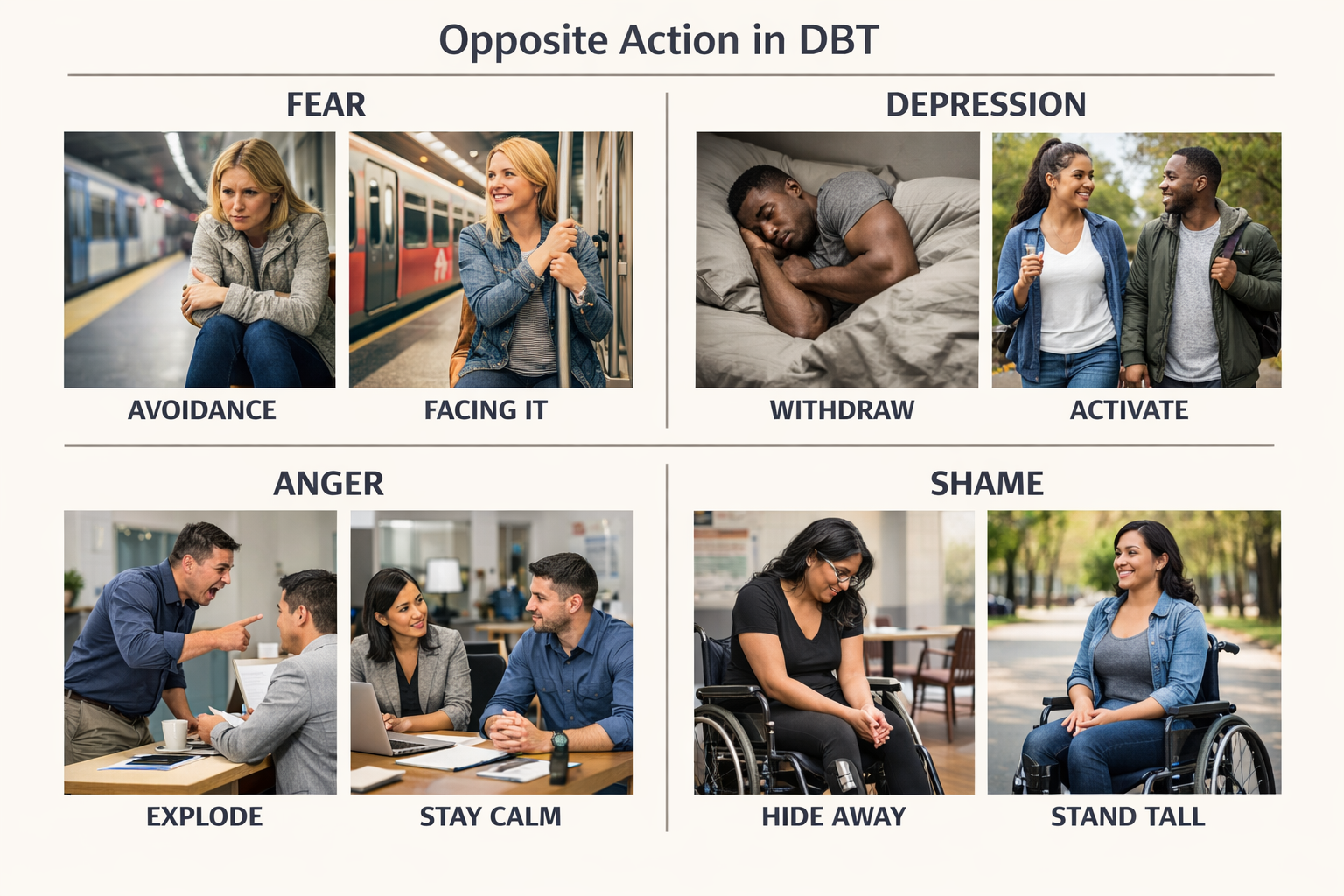
Opposite Action in DBT
Introduction: Why Opposite Action Is So Transformative
Dialectical Behavior Therapy (DBT) recognizes a central truth of human psychology: emotions evolved to motivate action, but they are not always accurate guides in modern life. Opposite Action is a skill designed to interrupt the cycle where emotions dictate behavior in ways that reinforce suffering.
Opposite Action is not suppression, denial, or pretending. It is a deliberate behavioral intervention used when:
- An emotion is too intense, or
- The emotion does not fit the facts, or
- Acting on the emotion would be harmful in the long term
By changing behavior first, Opposite Action leverages the bidirectional relationship between emotion, thought, and action.
The Core Logic of Opposite Action
Every emotion comes with:
- A biological sensation
- A cognitive interpretation
- An action urge
Opposite Action targets the action urge.
If you change the behavior while fully experiencing the emotion, the emotion will eventually change.
This works because:
- The nervous system updates based on experience
- Avoidance strengthens fear
- Withdrawal deepens depression
- Aggression escalates anger
- Hiding intensifies shame
Opposite Action interrupts reinforcement loops.
Opposite Action Across the Full Emotional Spectrum
1. Fear & Anxiety
Action urge: Avoid, escape, freeze
Opposite Action: Approach, engage, stay present
Example:
A person fears taking public transit after a disorienting past experience. Fear urges avoidance—driving, staying home, or relying on others.
Opposite Action involves:
- Riding transit intentionally
- Staying present with bodily sensations
- Gradual exposure rather than escape
Result:
The nervous system learns: “This is uncomfortable, not dangerous.” Fear diminishes through experience, not reassurance.
2. Depression
Action urge: Withdraw, sleep excessively, disengage
Opposite Action: Activate, move, connect
Example:
A depressed individual feels life is pointless and stays in bed. Waiting to “feel better” keeps depression entrenched.
Opposite Action includes:
- Getting dressed despite low energy
- Completing small tasks
- Social contact even without desire
Key insight:
Motivation follows action, not the reverse.
Result:
Energy and mood improve incrementally as behavior contradicts depressive inertia.
3. Anger
Action urge: Attack, blame, withdraw, dominate
Opposite Action: Gentleness, curiosity, respectful assertion
Example:
Someone feels furious at a colleague. Anger urges sarcasm or confrontation.
Opposite Action may involve:
- Lowering voice
- Listening first
- Stating needs calmly
Why this works:
Anger escalates when it meets resistance. Gentleness deactivates threat responses—both internally and interpersonally.
4. Shame
Action urge: Hide, collapse posture, avoid eye contact
Opposite Action: Stand tall, make eye contact, speak
Example:
A person feels ashamed after social awkwardness. Shame urges isolation and rumination.
Opposite Action includes:
- Maintaining open posture
- Continuing social engagement
- Speaking despite discomfort
Result:
Shame weakens when its central belief (“I must hide”) is disproven by survival and acceptance.
5. Guilt
Action urge: Apologize excessively, self-punish, submit
Opposite Action (when guilt is unjustified): Self-compassion, boundaries
Example:
Someone feels guilty for asserting a reasonable boundary. Guilt urges over-explaining and capitulation.
Opposite Action involves:
- Holding the boundary
- Acknowledging discomfort without repair
- Practicing self-validation
Result:
The person learns that discomfort does not equal wrongdoing.
6. Sadness / Grief
Action urge: Withdraw, numb, disengage
Opposite Action (when sadness is disproportionate): Reconnection, meaning-making
Important nuance:
Opposite Action is not used when sadness fits the facts (e.g., genuine grief). In those cases, allowing sadness is appropriate.
But when sadness becomes immobilizing:
- Gentle re-engagement
- Acts of meaning
- Symbolic action
help restore balance.
7. Love, Longing, Attachment Anxiety
Action urge: Cling, over-text, abandon self
Opposite Action: Self-soothing, autonomy, paced connection
Example:
Someone anxiously attached fears abandonment and urges reassurance-seeking.
Opposite Action:
- Delaying contact
- Engaging in self-regulation
- Allowing uncertainty
Result:
Attachment anxiety reduces as self-trust increases.
Common Misunderstandings About Opposite Action
❌ “It means ignoring emotions”
No. The emotion is fully acknowledged.
❌ “It’s fake or inauthentic”
No. It’s values-based behavior, not emotion-based behavior.
❌ “It works immediately”
Sometimes it doesn’t. It works cumulatively.
Why Opposite Action Builds Strength
Opposite Action:
- Builds distress tolerance
- Increases self-respect
- Restores agency
- Rewires emotional learning
- Reduces emotional dominance over identity
Over time, individuals stop asking:
“What does my emotion want me to do?”
and start asking:
“What kind of person do I want to be in this moment?”
Integration With the Dialectical Frame
Opposite Action is inherently dialectical:
- The emotion is valid
- The behavior is chosen
Both truths coexist.
This prevents:
- Emotional tyranny (emotion = truth)
- Emotional suppression (emotion = enemy)
Conclusion: From Emotional Slavery to Emotional Leadership
Opposite Action is not about becoming less emotional. It is about becoming emotionally sovereign.
By repeatedly acting opposite to unhelpful emotional urges—across fear, anger, shame, depression, guilt, and attachment anxiety—individuals learn a profound lesson:
I can feel deeply without being controlled.
This is one of DBT’s most enduring gifts: not emotional numbness, but emotional leadership.