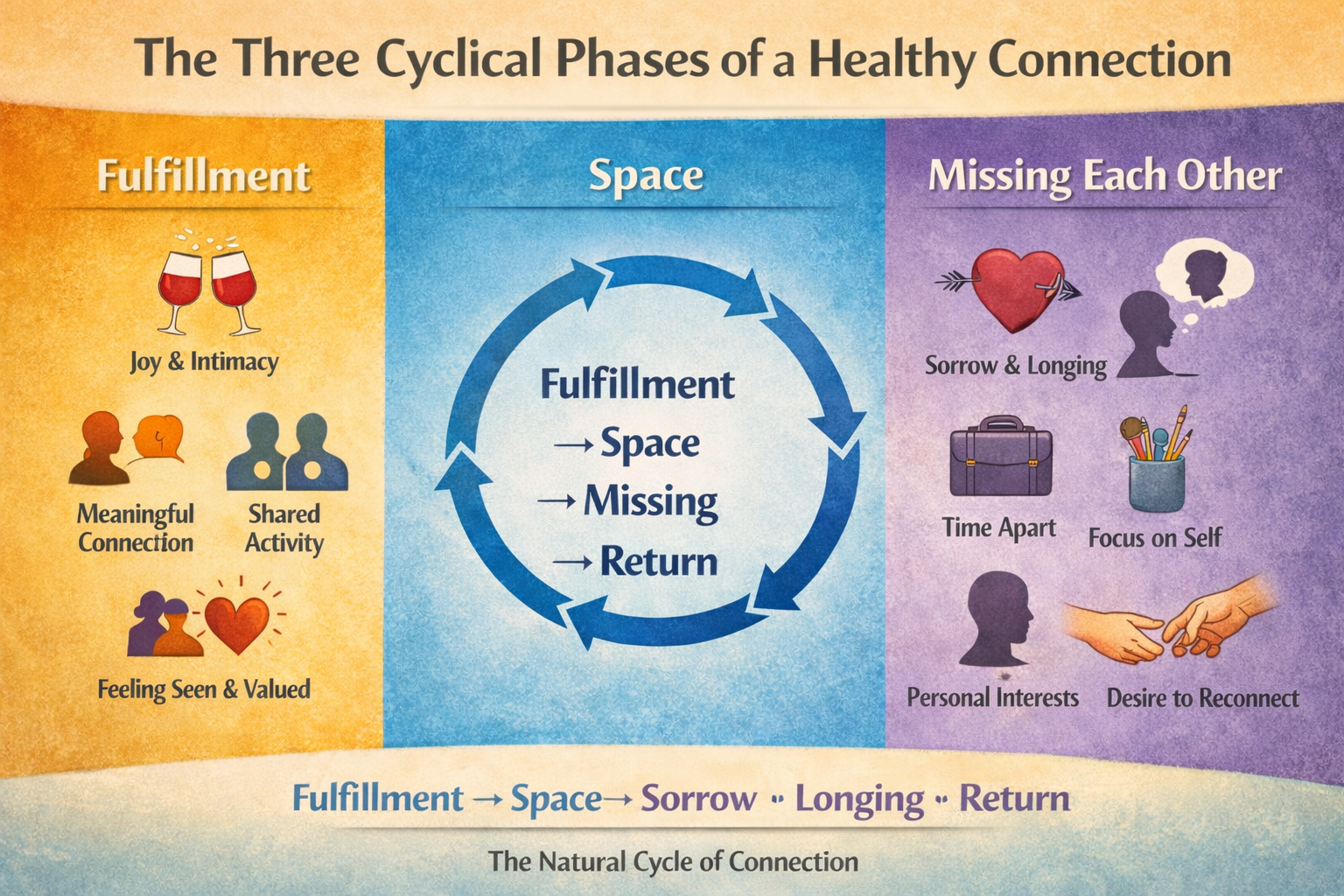
The Three Complementary, Cyclical Phases of a Healthy Connection
Every healthy connection—romantic, friendship, business partnership, family bond, even your relationship with your purpose—moves in a cycle. It is not a straight line and not a state of constant intensity. It is rhythmic. The three complementary parts of that rhythm are fulfillment, space, and missing each other. The natural order matters: fulfillment comes first, then space, then missing, and finally return. When this sequence is honored, connection strengthens over time. When it is disrupted, intensity may increase, but stability declines.
Fulfillment: Nourishing Contact
Fulfillment is the phase of genuine contact. It is shared presence that feels real and complete. In romance, it may include emotional intimacy and physical closeness. In friendship, it may be deep conversation or shared laughter. In business, it is productive collaboration grounded in mutual respect. In family, it is warmth, reliability, and shared meaning. During fulfillment, the nervous system settles because the attachment question—“Are we good?”—is answered clearly.
For fulfillment to support the cycle, it must be complete enough. If someone leaves the interaction feeling unseen, half-heard, or subtly dismissed, the system does not transition smoothly into space. Instead of calm separation, anxiety fills the gap. Rumination begins. Reassurance is sought. Subtle protest behaviors appear. A fulfilled system can separate peacefully; an undernourished system clings. The quality of fulfillment determines whether space will feel safe or threatening.
Space: Necessary Separation
After fulfillment comes space. Space is not rejection, punishment, or strategic withdrawal. It is healthy separation. It allows each person to return to individuality, responsibilities, and personal growth. In romantic bonds, this may look like time apart during the day, independent hobbies, or focused work. In friendships, it may be weeks without contact. In business, it is domain autonomy and independent execution. In families, it is developmental individuation.
Space preserves differentiation. Without differentiation, connection collapses into fusion. Fusion feels intense but slowly erodes respect and attraction. Two distinct individuals are required for sustainable connection. Space also prevents overconsumption. Constant proximity dulls appreciation and often leads to irritability. Finally, space creates the conditions for missing. You cannot miss what never leaves. Without absence, longing cannot form; without longing, desire flattens.
Missing Each Other: The Role of Sorrow
Missing each other is often misunderstood because it contains sorrow. When someone meaningful is absent, there is a small ache. A quiet tenderness. A recognition that something valuable is not here in this moment. This is not panic, abandonment terror, or emotional collapse. It is clean sorrow. Clean sorrow is functional and dignified. It says, “This mattered.”
Sorrow protects significance. You do not grieve what is meaningless. If separation produces no emotional response at all, the bond was shallow. Healthy missing feels contained and proportional. It does not destabilize the nervous system; it softens it. It proves that attachment exists and that value is real. In this way, sorrow has a positive, necessary role in life. It deepens emotional capacity and builds resilience. Learning to sit with small, clean sorrow strengthens patience, regulation, and trust in time.
When sorrow is allowed without suppression or dramatization, it naturally transforms into longing. Longing is voluntary desire. Anxiety says, “I must fix this immediately.” Longing says, “I really want to see you again.” That shift—from compulsion to choice—is the mark of mature connection. Missing becomes the bridge between attachment and renewal.
Return: Voluntary Reconnection
After longing builds, return becomes meaningful. Reunion is not driven by fear or obligation but by desire. The cycle completes itself: fulfillment leads to space, space leads to sorrow, sorrow evolves into longing, and longing leads to return. Each phase prepares the next. Without sorrow, return feels neutral. Without space, longing cannot arise. Without fulfillment, space feels dangerous. When all parts are intact, reconnection carries energy and depth.
How the Cycle Becomes Derailed
The cycle breaks in predictable ways. Overextension during fulfillment is common; constant contact and reassurance eliminate space, which eliminates missing. Desire dulls and irritation grows. Incomplete fulfillment is another derailment. If contact does not nourish deeply, space triggers insecurity rather than clean sorrow. The solution in such cases is not less space but better fulfillment.
Sorrow can also mutate. If separation activates old wounds, missing turns into panic. The body interprets absence as abandonment, leading to clinging, testing, or emotional volatility. Alternatively, sorrow may be numbed through distraction, replacement, or endless low-level contact. This flattens emotional depth and prevents longing from forming. In more distorted cases, sorrow is weaponized. Withdrawal is used to provoke pursuit, silence to induce anxiety, coldness to test loyalty. This transforms a healthy phase into manipulation and undermines trust.
Finally, some individuals tolerate space easily but avoid return. They prefer independence and resist re-entry into intimacy. In such cases, the cycle stalls at separation and the bond gradually dissolves. Healthy connection requires both the capacity to separate and the willingness to return.
Applications Across All Forms of Connection
This rhythm applies universally. Romantic relationships depend on oscillation to maintain attraction. Friendships survive distance when fulfillment was genuine and missing is allowed to deepen appreciation. Business partnerships thrive when autonomy and reconnection are balanced. Families remain healthy when individuation is permitted and reunion remains warm. Even your relationship with your work or purpose follows this pattern. Intense engagement must be followed by rest; rest creates renewed desire; renewed desire fuels return.
The Maturity Required
To live this cycle well requires three strengths: the courage to show up fully during fulfillment, the stability to allow space without panic, and the depth to feel sorrow without collapsing or manipulating. Many people disrupt connection because they fear one of these phases. They fear closeness, fear separation, or fear longing. But eliminating sorrow does not create strength; it creates shallowness. Allowing sorrow cleanly deepens the capacity for meaningful bonds.
Healthy connection is not constant proximity. It is rhythmic return. Fulfillment nourishes. Space differentiates. Sorrow deepens. Longing ignites. Return renews. When this natural order is honored, relationships grow stronger over time—not through intensity or control, but through trust in the cycle itself.