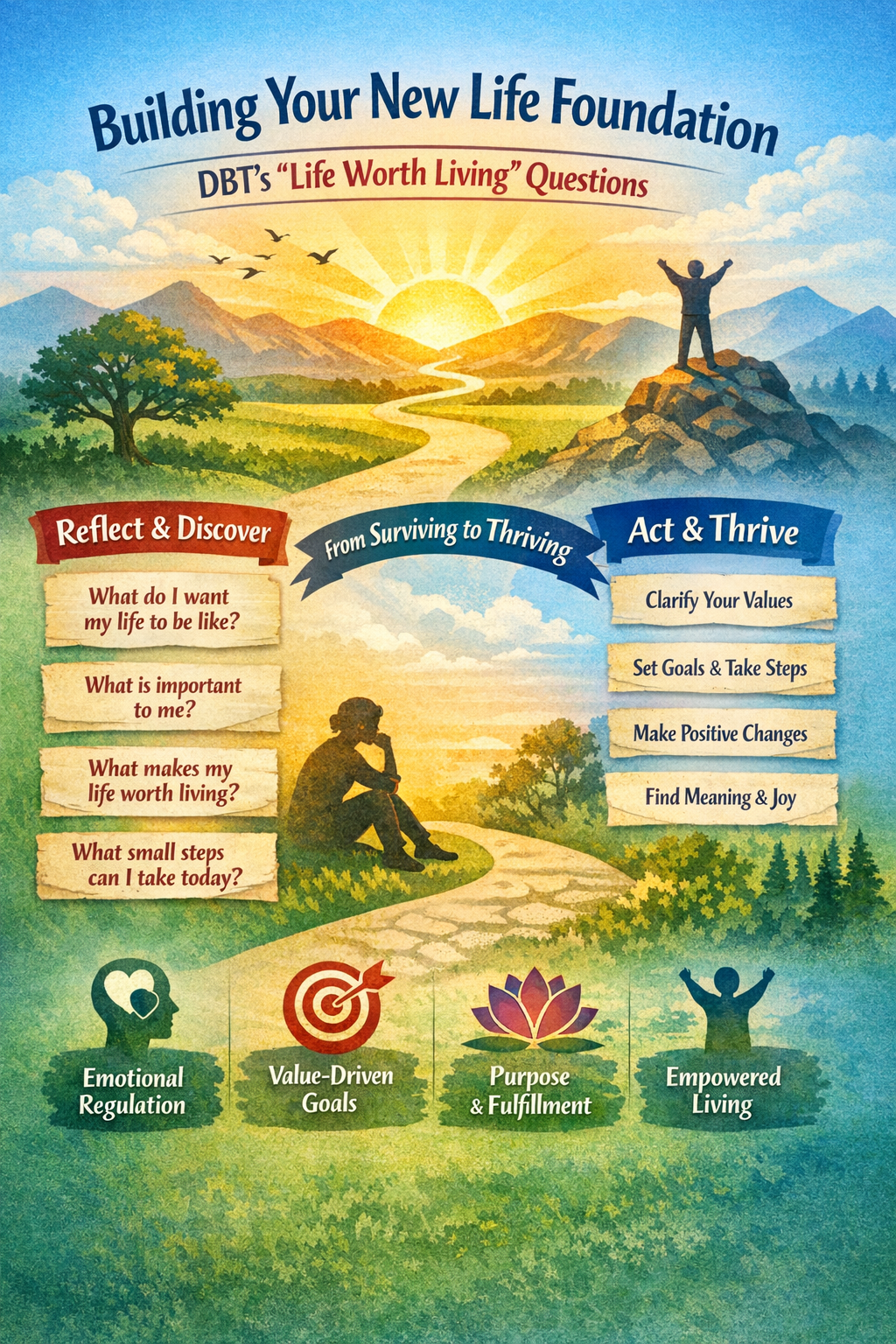
Building Your New Life Foundation
Introduction: Why Life Worth Living Questions Matter
Dialectical Behavior Therapy (DBT), developed by Marsha Linehan, is a structured cognitive-behavioral approach originally designed to help individuals struggling with intense emotions, self-harm, and borderline personality disorder. One of DBT’s distinctive features is its focus not just on symptom reduction, but on building a life worth living. The Life Worth Living (LWL) Questions are a set of reflective prompts that guide individuals in evaluating what truly gives their lives meaning, joy, and purpose.
These questions are not just about abstract philosophical reflection—they have practical, real-world impact. By regularly engaging with LWL Questions, individuals can:
- Clarify personal values and priorities
- Identify sources of satisfaction and fulfillment
- Cultivate motivation to make meaningful life changes
- Reduce emotional distress by creating a roadmap for a life aligned with one’s goals and values
In short, LWL Questions are a tool to bridge the gap between surviving and thriving, helping people move from reactive coping to intentional living.
1. The Origins and Purpose of LWL Questions
DBT is rooted in cognitive-behavioral techniques but adds dialectical philosophy—the idea that reality contains apparent opposites that can be synthesized. Linehan recognized that many clients struggling with chronic emotional pain also lack clarity about what makes life worth living. Without a sense of purpose, distress feels endless, and motivation to maintain treatment or personal change dwindles.
The Life Worth Living Questions were developed as a structured introspective tool to help clients:
- Reflect on their current situation
- Evaluate whether current actions align with desired outcomes
- Plan actionable steps toward fulfillment
By framing life through the lens of these questions, DBT encourages value-driven decision making, reinforcing behaviors that enhance life satisfaction rather than simply suppressing distress.
2. Core Life Worth Living Questions
While DBT does not have a universally fixed list, the Life Worth Living Questions typically focus on themes like:
- What do I want my life to be like?
- Encourages envisioning an ideal life, including relationships, work, and personal growth.
- What is important to me? What do I value most?
- Helps distinguish between superficial goals and core values.
- What am I willing to do to make my life better?
- Highlights actionable steps and commitment to change.
- What makes my life worth living?
- Prompts identification of sources of joy, meaning, and fulfillment.
- What small steps can I take today to align with this vision?
- Shifts focus from abstract goals to concrete, attainable actions.
By repeatedly engaging with these questions, individuals gain a clearer sense of purpose, which is critical when navigating challenges, managing intense emotions, or making life decisions.
3. Benefits of Using Life Worth Living Questions
A. Enhanced Emotional Regulation
When a person understands what makes their life worth living, they are less likely to react impulsively to distressing emotions. The LWL Questions provide a compass for decision-making, helping individuals pause and consider whether a reactive behavior aligns with their long-term goals.
For example: someone might feel the urge to lash out during a conflict. By recalling their LWL reflection—“I want relationships built on trust and respect”—they are more likely to respond intentionally rather than reactively.
B. Motivation and Goal Alignment
Regular reflection on LWL Questions reinforces motivation. Individuals begin to notice gaps between their actions and values, which encourages adjustments. This is especially useful in therapy or self-directed personal development, as it creates a roadmap for living intentionally rather than drifting through life passively.
C. Reduction in Existential Distress
People struggling with chronic emotional pain often experience existential questions: “Why am I here?” or “Does life have meaning?” LWL Questions help transform abstract existential angst into concrete reflection, allowing individuals to pinpoint sources of fulfillment and design a life that emphasizes them.
D. Improved Decision-Making
By clarifying priorities, LWL Questions reduce decision fatigue and impulsivity. When faced with multiple options or emotional triggers, an individual can ask:
- “Does this align with what I want my life to be?”
- “Does this support my values and sense of purpose?”
This framework helps guide both major life decisions and everyday choices.
E. Empowerment and Self-Efficacy
Engaging with LWL Questions fosters a sense of agency. Instead of feeling at the mercy of circumstances or emotions, individuals recognize their capacity to make meaningful choices. This builds confidence, resilience, and an enduring belief in personal growth.
4. How to Use Life Worth Living Questions Effectively
Step 1: Schedule a regular reflection time
- Set aside 10–15 minutes daily or weekly for journaling or quiet contemplation.
- Consistency matters more than length — regular practice reinforces insight.
Step 2: Write rather than just think
- Putting answers on paper increases clarity and retention.
- Writing helps reveal unconscious patterns or recurring themes.
Step 3: Be honest, not idealistic
- The exercise works best when the individual reflects truthfully on current life conditions.
- Acknowledge difficulties and gaps rather than forcing perfection.
Step 4: Break answers into actionable steps
- For every value or goal identified, create specific, attainable actions.
- Example: “I value meaningful connection” → “I will call a friend for a 10-minute conversation today.”
Step 5: Review and revise
- Periodically revisit previous answers to see if priorities or circumstances have changed.
- LWL reflection is dynamic, not static — what matters today may evolve.
5. Practical Examples of Life Worth Living Questions in Action
Example 1: Managing Work Stress
- Reflection: “I want to feel competent and respected at work.”
- Action: Schedule focused work periods and request constructive feedback rather than reacting defensively.
Example 2: Improving Relationships
- Reflection: “I want friendships built on trust and shared joy.”
- Action: Initiate contact, plan shared activities, or express appreciation intentionally.
Example 3: Self-Care and Health
- Reflection: “I value my physical and mental well-being.”
- Action: Set a daily exercise goal, maintain sleep schedule, or practice mindfulness for 10 minutes.
These examples show how abstract values translate into concrete life choices, reducing impulsivity and emotional chaos.
6. Integration with Other DBT Skills
Life Worth Living Questions are most effective when combined with other DBT skills:
- Mindfulness: Stay present when answering LWL questions; notice emotions without judgment.
- Distress Tolerance: Helps manage urges that conflict with long-term goals.
- Emotion Regulation: Identifies triggers and supports intentional responses aligned with values.
- Interpersonal Effectiveness: Guides behavior toward relationships that contribute to a life worth living.
By weaving LWL reflection into daily practice, individuals build a holistic system for emotional and behavioral mastery.
7. Common Challenges and How to Overcome Them
Challenge 1: Feeling Overwhelmed
- Life Worth Living reflection can initially highlight gaps between current life and ideals.
- Solution: Break reflection into smaller questions and focus on one area at a time.
Challenge 2: Repetitive or Stagnant Answers
- Over time, it can feel like nothing is changing.
- Solution: Ask different angles of the same question, e.g., “What makes today meaningful?” vs. “What makes my life meaningful overall?”
Challenge 3: Resistance or Skepticism
- Some may feel the questions are abstract or “too philosophical.”
- Solution: Anchor responses in daily lived experience and concrete actions.
8. Tips for Maximizing Impact
- Use a journal or digital note app specifically for LWL reflection.
- Pair with gratitude practice — noting things that are going well enhances motivation.
- Share insights with a therapist or trusted friend — accountability improves follow-through.
- Revisit goals frequently — life priorities evolve, and reflection should evolve too.
- Celebrate small wins — aligning actions with values is a skill that grows over time.
9. The Transformative Potential of Life Worth Living Questions
Engaging with LWL Questions is not just an exercise in introspection — it is a transformative tool for building a life that is intentional, resilient, and meaningful. Individuals often report:
- Increased clarity about what truly matters
- Reduced impulsive or destructive behaviors
- Greater emotional stability and confidence
- Enhanced sense of purpose and personal agency
By turning reflection into actionable life design, LWL Questions help individuals move from surviving to thriving, even in the face of emotional pain or difficult circumstances.
10. Conclusion
DBT’s Life Worth Living Questions are more than therapeutic tools—they are a guide for intentional living. By asking: “What makes my life worth living?”, “What do I value most?”, and “What concrete steps can I take today?”, individuals can translate abstract desires into practical, meaningful actions.
Consistent engagement with these questions cultivates:
- Emotional regulation
- Motivated, value-driven decision-making
- A sense of purpose and fulfillment
Whether you are struggling with intense emotions, chronic stress, or simply seeking more clarity in life, the Life Worth Living Questions offer a framework for reflection, growth, and meaningful action. By integrating these reflections into daily practice, anyone can build a life that is truly worth living.
Here is the questionnaire that I use with clients, that may give you some ideas for developing your own:
Life Worth Living Goal Setting Questionnaire
Core Values & Meaning
1. What does a life worth living look like for you?
2. What values are most important to you in life?
3. If you could design a perfect day, what would it include?
4. What gives you a sense of purpose or fulfillment?
5. What kind of person do you want to be?
6. What’s one thing that makes you feel alive?
Relationships & Connection
7. Who are the people that make your life meaningful?
8. What kind of relationships do you want to build?
9. How do you want to be remembered by those you love?
10. What qualities do you value in friendships and romantic relationships?
Personal Growth & Achievement
11. What are some skills or talents you want to develop?
12. What are your long-term goals, and why do they matter to you?
13. How do you handle challenges in a way that aligns with your values?
14. If failure wasn’t an option, what would you pursue?
15. What’s a past struggle that helped you grow?
Joy & Enjoyment
16. What activities bring you happiness or peace?
17. When was the last time you felt truly content?
18. How do you incorporate fun and pleasure into your life?
19. What small moments in life make you grateful?
Health & Well-Being
20. How do you take care of your physical health?
21. How do you take care of your mental well-being?
22. What habits help you feel grounded and balanced?
23. What’s one change you could make to improve your self-care?
Existential & Legacy Questions
24. What do you want your legacy to be?
25. How do you find hope even in difficult times?
26. If you had only one year left to live, how would you spend it?
27. What kind of impact do you want to leave on the world?