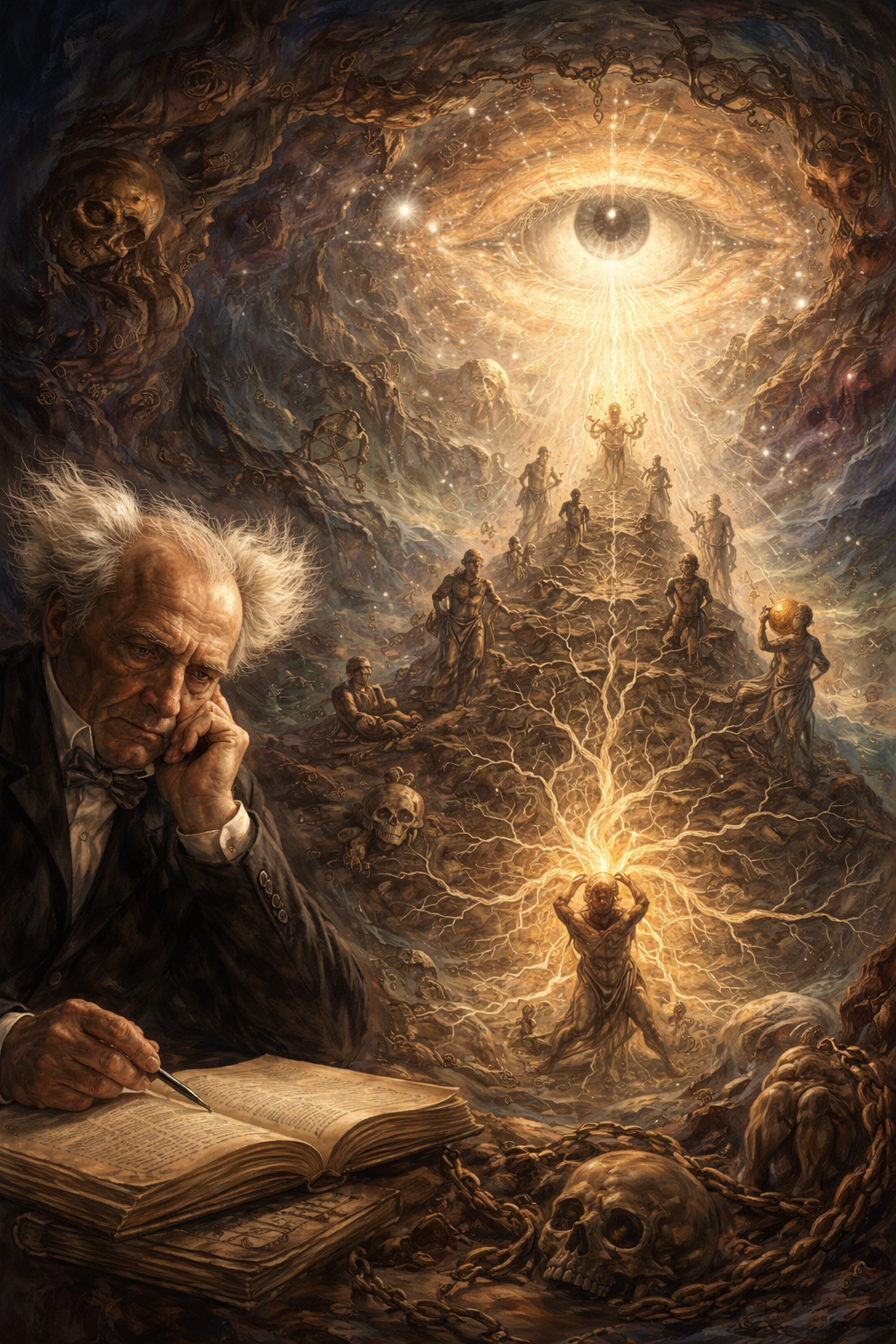
Why Desire Precedes Meaning
Arthur Schopenhauer, one of the most penetrating philosophers of the 19th century, proposed a radical idea about human motivation: beneath our reason, values, and even personality lies a more fundamental force. He called it the Will to Life. This is not ambition, optimism, moral striving, or any conscious plan for self-improvement. It is a blind, pre-rational drive toward existence, continuation, and expression. It is not something we choose—it is something that animates us. Our plans, goals, relationships, and moral systems are secondary structures built on top of a deeper current that simply wants to be, to move, and to experience.
In practical terms, the Will to Life explains a great deal about human behavior. Consider the moments when people act contrary to their stated principles, against their own interests, or even to their long-term wellbeing. We might know that a relationship is harmful, a career path unwise, or a habit destructive, yet still feel compelled to engage. For Schopenhauer, this is not a moral failing or lack of discipline. It is the vital, pre-rational energy of the Will, asserting itself independent of reason or conscious choice.
The Will Leads, Consciousness Follows
Schopenhauer’s claim challenges our intuitive sense of self-direction. Modern culture often places reason, reflection, and planning at the center of human life. But according to Schopenhauer, consciousness does not lead the will; the will leads consciousness. Our thoughts, decisions, moral reasoning, and even self-identity are shaped by a deeper, more primal force that existed long before the ego constructed itself.
This idea resonates with contemporary psychology, particularly with what is now understood about motivational drives, anticipation, and the brain’s reward system. Neuroscience shows that many of our actions are first initiated by subconscious drives or desires before rational thought catches up to justify them. Emotional tension, desire, and anticipation often mobilize far more energy than comfort or certainty. We feel most alive not when everything is neatly resolved, but when something meaningful is in motion—a goal we pursue, a challenge we face, or even a moment of tension in human connection. The future pulls us forward before we can fully articulate why.
Desire as the Source of Suffering
Schopenhauer was famously pessimistic about this force. In his view, the Will to Life is the root of endless striving—and, therefore, suffering. Human beings are never satisfied for long. Achieving a goal, obtaining an object, or reaching a milestone temporarily reduces desire, but the will quickly seeks a new object. Happiness and satisfaction are fleeting because the Will itself cannot rest. In this framework, life is a cycle of wanting, temporary fulfillment, and renewed desire, where peace is found not in acquisition but in restraint and clarity.
This insight explains familiar human experiences: why a promotion or purchase that once seemed essential can leave us unsatisfied, or why a completed relationship may be followed by longing for something new. The Will to Life, by its very nature, is restless, irrepressible, and pre-rational. We are not failing when we feel this pull; we are living it.
The Contemporary Reading: Channeling Vitality
While Schopenhauer’s original tone was deeply pessimistic, modern thinkers have found a more balanced perspective. The problem is not the Will to Life itself; it is how we relate to it. Most suffering arises when we confuse raw vitality with outcomes—when we project the will onto people, possessions, careers, or fantasies. By doing so, we bind our sense of aliveness to fragile, impermanent objects. When the objects fail—or inevitably change—we feel emptiness or loss, mistaking it for a deficiency in ourselves rather than the natural motion of the Will.
By contrast, recognizing the Will as an internal current rather than a contingent outcome allows for conscious engagement. Instead of being passively driven, we can learn to contain, direct, and integrate this energy, transforming it from chaotic restlessness into constructive momentum. This requires a subtle but powerful shift in perception: the energy that moves us is not the goal itself, but the experience of moving, striving, and engaging.
Vitality Comes From Engagement
Practical experience supports this philosophical insight. People who report the highest levels of fulfillment and resilience often embrace tension, uncertainty, and challenge rather than seeking only comfort. Whether it is volunteering, creative work, athletic pursuit, or complex relationships, life feels most alive in the process rather than in the completion.
- A writer may feel most energized while drafting and struggling with ideas, even if publication or recognition comes later.
- An athlete may experience the deepest satisfaction during training, not during medals or trophies.
- A volunteer may feel most connected to purpose in the act of helping itself, rather than in accolades or feedback.
The Will to Life thrives in movement, engagement, and expression, not in the static accumulation of external rewards.
The Psychology of Desire
Modern psychology reinforces Schopenhauer’s claims. Motivational psychology, self-determination theory, and cognitive neuroscience all highlight the energizing effect of desire and tension. Human beings are wired to respond more strongly to anticipation than fulfillment. Dopamine, the chemical associated with reward, is released in expectation of a goal, not merely in achieving it. This means our vitality often peaks before satisfaction is attained.
Understanding this mechanism reframes our approach to ambition and goal-setting. Rather than seeking permanent resolution or external validation, the challenge becomes channeling desire intelligently, using tension and striving as fuel, rather than letting them dominate our psychological landscape.
Containment, Mastery and the Art of Life
One of the most important practical lessons from Schopenhauer is the idea of containment. The Will is not something to suppress entirely—doing so can lead to frustration, neurosis, or stagnation. Instead, mastery comes from holding the force within conscious awareness and directing it in ways aligned with values, purpose, and long-term growth.
Containment is akin to holding energy in a reservoir, rather than spilling it indiscriminately. This applies to many domains:
- Emotional containment: managing impulses in relationships and social life.
- Creative containment: focusing restless energy into a single project or discipline.
- Physical containment: channeling drive into fitness, skill-building, or other embodied practices.
By consciously steering the Will, we cultivate a sense of autonomy and sovereignty over our lives. Rather than being reactive to fleeting desires or circumstances, we use the Will as a source of vitality, creativity, and engagement.
The Will and Meaning
Why does desire precede meaning? Because meaning is not something we find in the world—it is constructed through engagement with the Will. Experiences, relationships, achievements, and challenges acquire significance because they are infused with the energy of our striving.
- A volunteer may feel purpose not because of accolades, but because their action is a direct expression of vitality.
- An artist may feel fulfillment not from fame, but from the act of creating under tension.
- A thinker or philosopher feels alive when wrestling with ideas, not simply when publishing conclusions.
Meaning, in this sense, is the shadow cast by the Will onto the objects, processes, and relationships through which it expresses itself. Without desire, tension, or striving, meaning is elusive; with them, it flows naturally.
Implications for Everyday Life
- Shift the focus from outcomes to process
- Life is less about achieving “final goals” and more about participating fully in ongoing processes.
- Career, relationships, and creativity are arenas for engagement, not just acquisition.
- Recognize restlessness as natural, not pathological
- Feeling unsatisfied, restless, or eager does not indicate failure. It reflects the natural rhythm of the Will to Life.
- Channel energy consciously
- Avoid projecting the Will onto fragile external objects.
- Engage with projects, people, and challenges that contain and direct energy constructively.
- Balance action with reflection
- Schopenhauer’s pessimism highlights suffering; contemporary application emphasizes conscious integration.
- Reflection allows us to identify where the Will is being squandered versus where it is building growth.
Volunteering, Creativity, and Engagement as Practical Expression
Volunteers are often driven by the Will before rational goals or moral considerations. The desire to help, to connect, to act, arises spontaneously. When channeled effectively, this raw energy produces both personal transformation and social impact.
Similarly, creative pursuits, skill mastery, or physical disciplines provide structured outlets for the Will. The struggle itself—the tension, uncertainty, and effort—is where life is most vividly experienced. Completion or reward is secondary; it is the process that invigorates the consciousness.
Conclusion: Living with the Will
Schopenhauer’s insight into the Will to Life remains deeply relevant. Before asking “What do I want?” or “What should I do?”, it is worth clarifying what primal inner psychological force is driving that desire. Desire is not a mistake, weakness, or flaw; it is the engine of vitality. Understanding it allows us to live more intentionally, balancing the energy of striving with conscious direction, containment, and purpose.
In essence:
- The Will to Life precedes meaning.
- Meaning is constructed through engagement with tension, desire, and growth.
- Fulfillment comes not from ownership, resolution, or external reward, but from being animated, directed, and alive in the world.
To live wisely is not to extinguish the Will, but to channel it skillfully. Every act of engagement, reflection, and conscious striving is a moment of alignment between our deepest impulses and our highest understanding. In this way, Schopenhauer’s pessimistic diagnosis becomes a roadmap: recognize the force, respect it, and guide it—so that life is not merely survived, but truly lived.