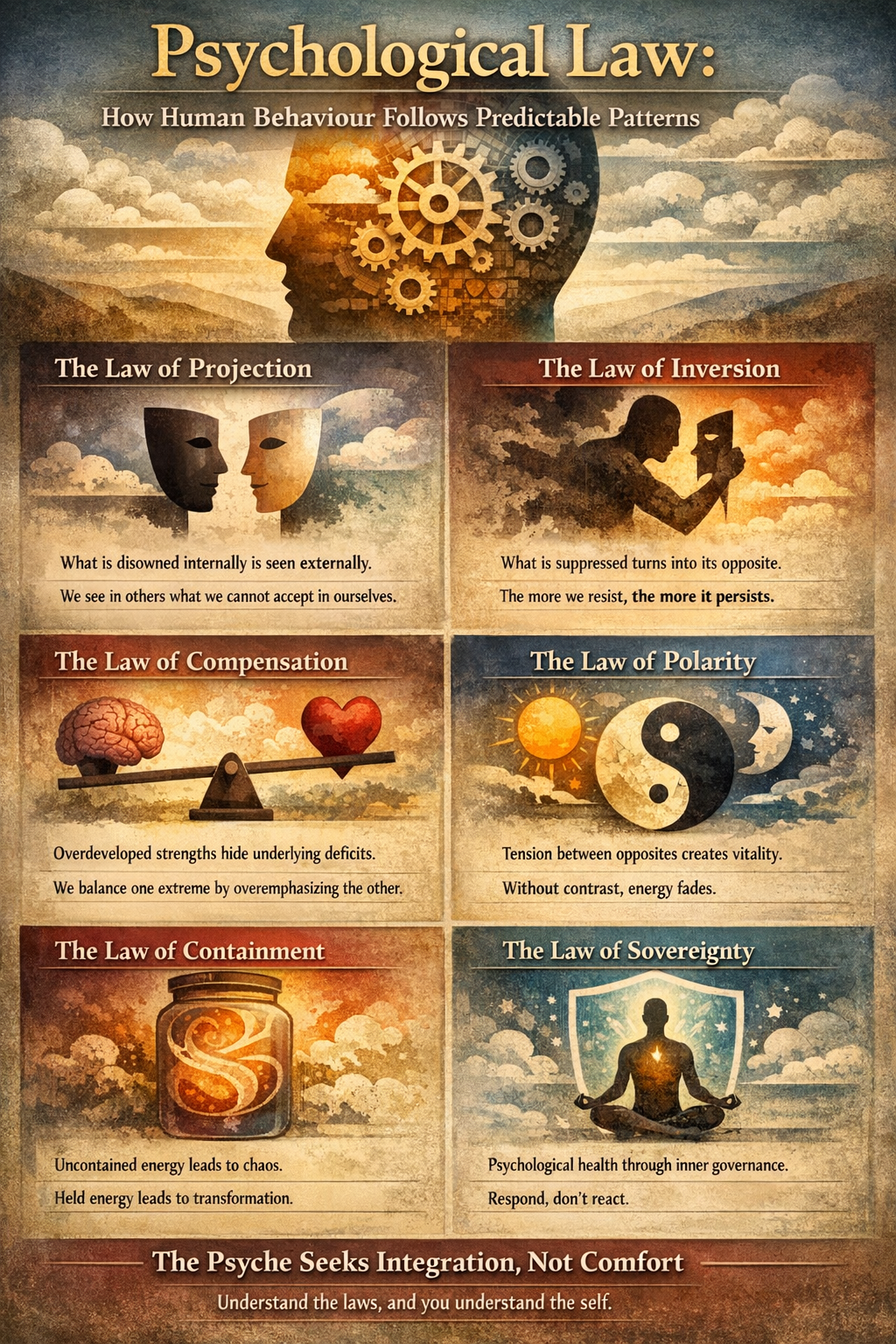
6 Psychological Laws
Human behaviour is often treated as a matter of preference, personality, or moral character. We speak of people as choosing badly, lacking willpower, or holding flawed values. Yet when examined closely, much of human psychology behaves less like a collection of choices and more like a system governed by repeatable patterns. These patterns operate with such consistency that they resemble laws.
Psychological laws are not moral prescriptions. They do not describe how people should behave, nor do they imply virtue or fault. Instead, they describe how the psyche organizes energy, maintains coherence, and responds to internal conflict. Like physical laws, they function whether one believes in them or not. Ignorance does not exempt a person from gravity; nor does it exempt them from projection, compensation, or inversion.
These laws reveal something counterintuitive: the psyche does not primarily seek comfort, happiness, or social harmony. It seeks integration. It seeks to preserve wholeness, manage tension, and maintain internal order with the least expenditure of energy. When conscious awareness fails to accommodate certain forces, the psyche reroutes them through indirect channels. Symptoms, compulsions, relational patterns, and ideological rigidity are not random flaws — they are adaptive responses to unintegrated material.
What follows is not a comprehensive psychology, but a structural one: a set of recurring dynamics that shape perception, desire, conflict, and power across individual and collective life.
The Law of Projection
The Law of Projection states that unintegrated aspects of the self are perceived as qualities of others. What cannot be consciously owned must be experienced externally.
Projection is often misunderstood as a mistake — an error in judgment or a sign of immaturity. In reality, projection is a stabilizing mechanism. The psyche preserves internal coherence by relocating disowned material into the environment, allowing the individual to remain psychologically intact even when awareness is limited.
Traits that are projected can be negative or positive. Aggression, envy, weakness, and selfishness are common candidates, but so are vitality, authority, creativity, and erotic power. What matters is not the moral valence of the trait, but whether it has been integrated into conscious identity.
Attraction and aversion are therefore not accidents. They are diagnostic signals. Intense admiration often indicates latent potential that has not yet been claimed. Intense hostility frequently signals a quality the individual carries but cannot tolerate recognizing. The psyche says, in effect: If I cannot be this, I must see it out there.
Projection explains why certain people provoke disproportionate reactions. Why one coworker feels threatening while another is invisible. Why one public figure becomes a moral obsession. Why romantic partners are imbued with exaggerated significance. The external figure is carrying psychic weight that does not belong to them.
Importantly, projection does not disappear through intellectual insight alone. Knowing one is projecting does not immediately reclaim the projected material. Integration requires tolerating the internal experience of the trait — including its tension, responsibility, and ambiguity. Until that occurs, the psyche will continue to externalize what it cannot yet hold.
The Law of Inversion
The Law of Inversion holds that what is resisted internally gains power externally. Suppressed traits do not vanish; they invert.
The psyche cannot destroy energy. It can only redirect it. When a trait, impulse, or capacity is deemed unacceptable, it does not cease to exist. Instead, it reappears in distorted or exaggerated form — often as moral rigidity, obsession, contempt, or fascination.
For example, suppressed aggression may invert into passive-aggression, sanctimony, or ideological purity. Suppressed sexuality may invert into fixation, compulsive behavior, or moral panic. Suppressed dependency may invert into hyper-independence and disdain for vulnerability. In each case, the original energy remains active but unacknowledged.
The paradox of inversion is that resistance strengthens the very thing one seeks to eliminate. The harder a person fights a trait internally, the more tyrannical its indirect expressions become. This is why repression often produces caricatures: exaggerated behaviors, rigid identities, and brittle moral stances.
Inversion also explains why social movements, institutions, and belief systems can become extreme. When a collective identity is built on disavowal — “we are not like that” — the rejected quality does not disappear. It re-emerges as obsession with enemies, purity tests, or symbolic scapegoats.
Integration does not mean indulgence. It means recognition. When a trait is consciously acknowledged, its energy becomes available for modulation rather than domination. What is owned can be governed; what is resisted governs from the shadows.
The Law of Compensation
The Law of Compensation describes how deficits in one domain provoke overdevelopment in another. When balance is lost, the psyche seeks equilibrium by amplifying a substitute function.
Compensation is not pathological in itself. It is an intelligent adaptation. Emotional deprivation may lead to intellectualization. Physical weakness may lead to strategic thinking. Early chaos may produce exceptional orderliness. These adaptations often produce real skill and achievement.
The problem arises when compensation is mistaken for wholeness.
A person who compensates for insecurity with dominance may appear powerful while remaining fragile. A person who compensates for emotional absence with productivity may appear disciplined while remaining disconnected. Over time, the compensatory structure becomes rigid, requiring constant reinforcement.
Because compensation stabilizes the system in the short term, it is rewarded — socially, professionally, and internally. But it carries a hidden cost. The neglected domain does not disappear. It remains underdeveloped, reactive, and easily destabilized. When stress exceeds the compensatory capacity, the system collapses or becomes symptomatic.
Compensation explains why many high-functioning individuals experience sudden breakdowns, relational failures, or existential crises later in life. The overdeveloped function can no longer carry the weight of what was avoided.
True integration requires redistributing energy back toward neglected capacities. This often feels like regression — becoming less certain, less impressive, less defended. In reality, it is rebalancing.
The Law of Polarity
The Law of Polarity asserts that psychological energy requires tension between opposites to remain alive.
Meaning, desire, and vitality emerge from difference held in relation. Masculine and feminine, autonomy and connection, order and chaos, restraint and expression — these tensions generate movement. When polarity collapses, energy dissipates.
Polarity does not imply hostility. It implies distinction. Healthy systems preserve difference without requiring domination. When difference is erased through enmeshment, forced sameness, or ideological flattening, desire decays. What remains is stagnation, boredom, or resentment.
This law operates in individuals and relationships alike. Internally, a person must hold competing impulses without prematurely resolving them. Externally, relationships require space, contrast, and asymmetry to remain alive. Total transparency, total equality, or total fusion may feel safe, but they often drain vitality.
Polarity also explains why conflict is not inherently destructive. Conflict, when contained, signals active tension. The absence of conflict may signal suppression or disengagement rather than harmony.
A psyche that cannot tolerate polarity seeks resolution through collapse — either into chaos or rigidity. A psyche that can hold polarity develops resilience, creativity, and depth.
The Law of Containment
The Law of Containment explains that uncontained energy seeks discharge, while contained energy transforms.
Libido, aggression, grief, curiosity, and ambition are raw forces. When they lack structure, they spill into compulsive behavior, acting out, or destructive cycles. When held within a stable psychological container, the same energies reorganize personality toward coherence and purpose.
Containment does not mean suppression. It means providing sufficient structure for energy to be metabolized rather than expelled. This structure can take many forms: reflective capacity, ethical frameworks, disciplined practice, symbolic expression, or relational boundaries.
A child who lacks containment discharges emotion behaviorally. An adult who lacks containment does the same — but with greater consequences. Addiction, reactivity, and compulsive relational patterns often reflect insufficient containment rather than excessive intensity.
When energy is contained, it undergoes transformation. Sexual energy becomes creativity. Aggression becomes assertiveness. Grief becomes meaning. Containment allows the psyche to convert raw force into usable form.
Without containment, the psyche remains reactive. With containment, it becomes generative.
The Law of Sovereignty
The Law of Sovereignty states that psychological health increases in proportion to internal governance.
Sovereignty refers to the capacity to hold experience without immediately discharging it through action, justification, or outsourcing authority. A sovereign psyche can experience desire without compulsion, anger without violence, fear without paralysis.
This capacity reduces susceptibility to manipulation. The less a person is ruled by their unconscious material, the less they are ruled by others’ projections, demands, and emotional contagion. Sovereignty creates psychological boundaries that are felt rather than enforced.
Importantly, sovereignty is not control in the rigid sense. It is responsiveness rather than reactivity. A sovereign individual can be influenced without being overridden, connected without being absorbed.
At the collective level, loss of sovereignty manifests as ideological possession, moral panic, and crowd behavior. At the individual level, it manifests as impulsivity, resentment, and dependency.
Sovereignty grows through integration, containment, and the capacity to tolerate internal tension. It cannot be granted externally. It must be cultivated.
Conclusion: The Psyche Does Not Want Comfort
Taken together, these laws describe a psyche oriented not toward comfort, but toward integration.
Comfort seeks relief from tension. Integration seeks the capacity to hold it. Comfort avoids contradiction. Integration metabolizes it. Comfort pursues equilibrium through avoidance; integration achieves coherence through inclusion.
Symptoms are not enemies. They are signals of unintegrated forces seeking expression. Patterns are not moral failures. They are adaptive strategies that have outlived their usefulness.
Psychological growth does not occur through eradication of traits, but through their conscious incorporation into a larger, more flexible structure. What is integrated becomes available. What is rejected becomes fate.
The laws outlined here do not promise ease. They promise intelligibility. They offer a way to read behavior — one’s own and others’ — as lawful rather than chaotic, meaningful rather than arbitrary.
The psyche, like any complex system, follows rules. To ignore them is costly. To understand them is power.
And to live by them is not to become comfortable — but to become whole.