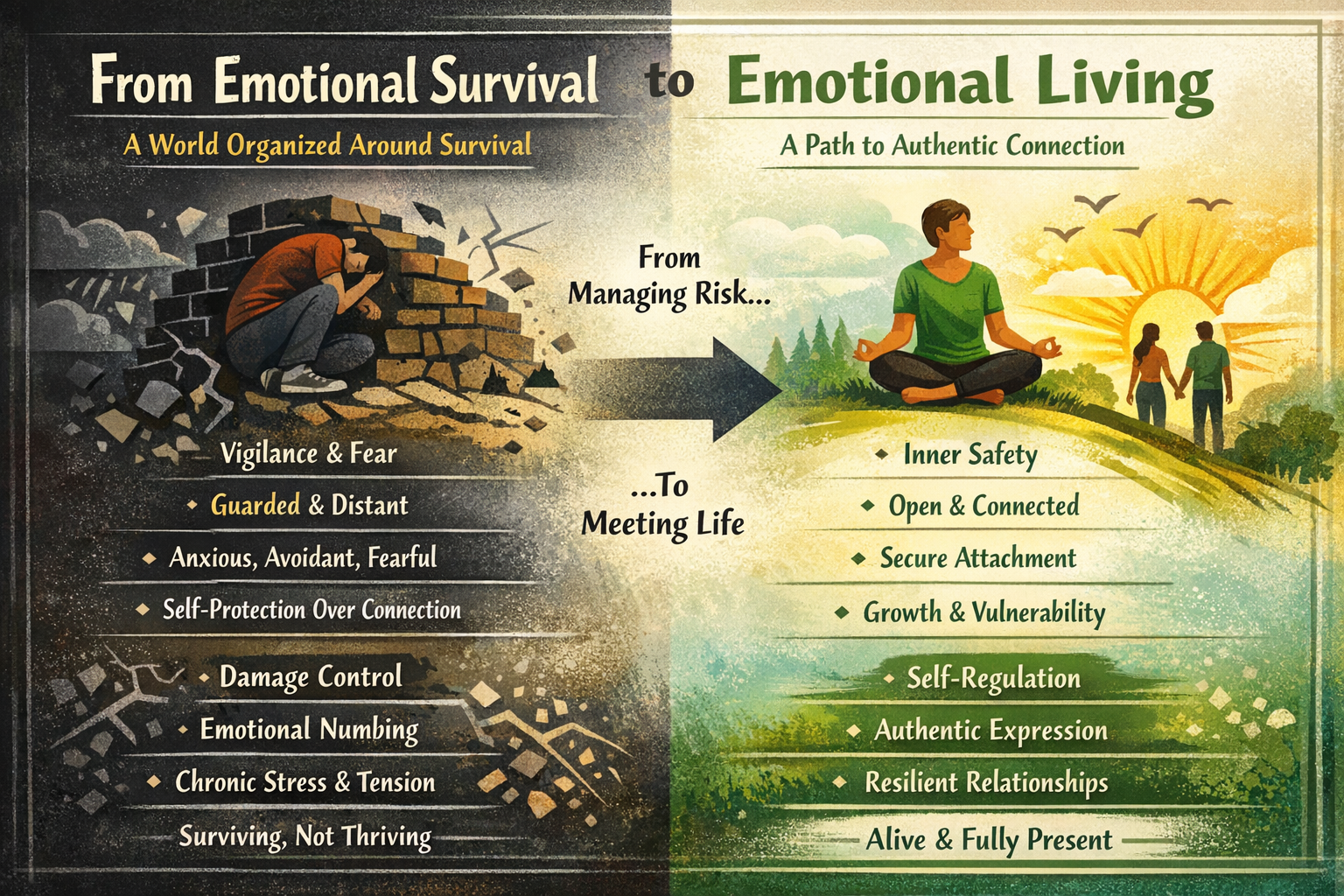
A World Organized Around Survival
Most people believe they are living emotionally. In reality, they are surviving. Their inner world is organized less around curiosity, intimacy, and growth, and more around threat management, damage control, and self-protection. This is not a moral failing or a personal weakness—it is a nervous-system adaptation. Modern life is saturated with unresolved relational trauma, developmental misattunement, and chronic stress, and the psyche adapts accordingly.
Attachment theory gives us one of the clearest lenses through which to see this. When we look honestly at anxious, avoidant, and fearful-avoidant attachment styles, a single theme emerges: they are all survival strategies. They are not personality quirks. They are not preferences. They are learned responses to environments where emotional safety was inconsistent, conditional, or absent.
To understand what it means to move beyond survival, we first have to name it clearly.
Survival Mode: The Emotional Default
Survival mode is not a constant feeling of panic. It is far more subtle—and therefore far more pervasive. It is a background orientation toward life in which the nervous system assumes that something, somewhere, will go wrong if vigilance is relaxed.
In emotional survival mode:
- Connection is monitored, not inhabited
- Emotions are managed, not felt
- Relationships are negotiated, not rested in
- Self-expression is filtered through fear of consequence
People in survival mode may appear functional, successful, even confident. But internally, their system is always scanning: Am I safe? Am I wanted? Am I too much? Not enough? About to lose something?
This constant low-grade alertness shapes attachment.
Non-Secure Attachment Styles as Survival Strategies
Anxious Attachment: Survival Through Proximity
Anxious attachment organizes itself around the fear of abandonment. The nervous system learned early that connection was unpredictable, so it compensates by amplifying signals.
Key features include:
- Hyper-focus on the other
- Difficulty self-soothing
- Heightened sensitivity to cues of withdrawal
- Urgency around reassurance
At its core, anxious attachment is asking: “If I stay close enough, attentive enough, good enough, will I survive emotionally?”
This is not neediness—it is survival logic.
Avoidant Attachment: Survival Through Distance
Avoidant attachment learns the opposite lesson: closeness is dangerous. Needs were ignored, minimized, or punished, so the system adapts by shutting them down.
Common features include:
- Emotional self-sufficiency
- Discomfort with dependence
- Devaluation of intimacy
- Withdrawal under relational pressure
Avoidant attachment is asking: “If I don’t need, don’t lean, don’t open, I won’t be hurt.”
Again, this is not coldness. It is protection.
Fearful-Avoidant Attachment: Survival Through Oscillation
Fearful-avoidant attachment is the most visibly survival-driven. It emerges when closeness was both desired and dangerous.
This creates:
- Intense longing for intimacy
- Intense fear of being seen
- Push–pull dynamics
- Sudden reversals of feeling
The nervous system here is trapped between two threats: abandonment and engulfment. Every move feels risky.
Fearful-avoidant attachment is asking: “How do I survive when what I need is also what hurts me?”
The Cost of Emotional Survival
Living in survival mode comes at a steep price.
Chronic Dysregulation
The body rarely settles. Even during calm moments, there is underlying tension. This leads to fatigue, irritability, and emotional volatility.
Shallow or Turbulent Relationships
Survival-based relating cannot sustain depth. Relationships become arenas for reassurance, control, or escape rather than mutual presence.
Loss of Authentic Self
When emotions are filtered through fear, people lose contact with their spontaneous self. Desire, creativity, and joy narrow.
Mistaking Familiarity for Truth
Perhaps most damaging: survival mode feels normal. Many people mistake vigilance for insight, independence for strength, and emotional shutdown for maturity.
Secure Attachment: The Alternative
Secure attachment is not the absence of need, fear, or pain. It is the presence of internal safety.
A secure system is characterized by:
- The ability to self-regulate emotions
- Comfort with closeness and autonomy
- Trust in one’s own experience
- Capacity for repair after rupture
Secure attachment does not ask, “How do I survive this relationship?” It asks, “Can I be fully here without losing myself?”
This is a fundamentally different orientation.
Emotional Living vs Emotional Survival
The shift from survival to living is subtle but profound.
In emotional living:
- Emotions are signals, not threats
- Connection is exploratory, not defensive
- Boundaries are natural, not rigid
- Vulnerability is chosen, not compulsive
Living emotionally means the nervous system has learned that discomfort is tolerable and repair is possible.
How Do We Get There?
1. Regulation Before Insight
No amount of intellectual understanding will rewire a dysregulated system. Practices that stabilize the nervous system—sleep, movement, breath, somatic awareness—are foundational.
2. Tolerating Emotional Ambiguity
Survival mode demands certainty. Secure attachment grows when we learn to stay present without immediate answers, reassurance, or withdrawal.
3. Experiencing Repair
Healing does not come from perfect relationships, but from repaired ones. Staying through rupture and experiencing reconnection rewires expectation.
4. Differentiating Past from Present
Survival patterns are often echoes. Learning to distinguish old threats from current reality is a skill developed through reflection and lived experience.
5. Choosing Presence Over Protection
Again and again, the path forward asks the same question: Can I stay open here without abandoning myself?
Why Most People Never Leave Survival Mode
Because survival works—until it doesn’t.
It protects against immediate pain. It preserves identity. It feels like control. Letting go of it can feel like stepping into danger, even when the danger is gone.
Growth requires risk. Emotional living requires faith—not blind faith in others, but trust in one’s own capacity to regulate, respond, and recover.
Conclusion: From Managing Risk to Meeting Life
Survival mode is understandable. It is adaptive. It may even be necessary early in life. But it is not the end point.
The alternative is not constant happiness or perfect intimacy. The alternative is aliveness. The capacity to feel deeply without collapsing, to connect without disappearing, to stand in one’s own emotional center while meeting another.
Most people are surviving.
Some choose to live.