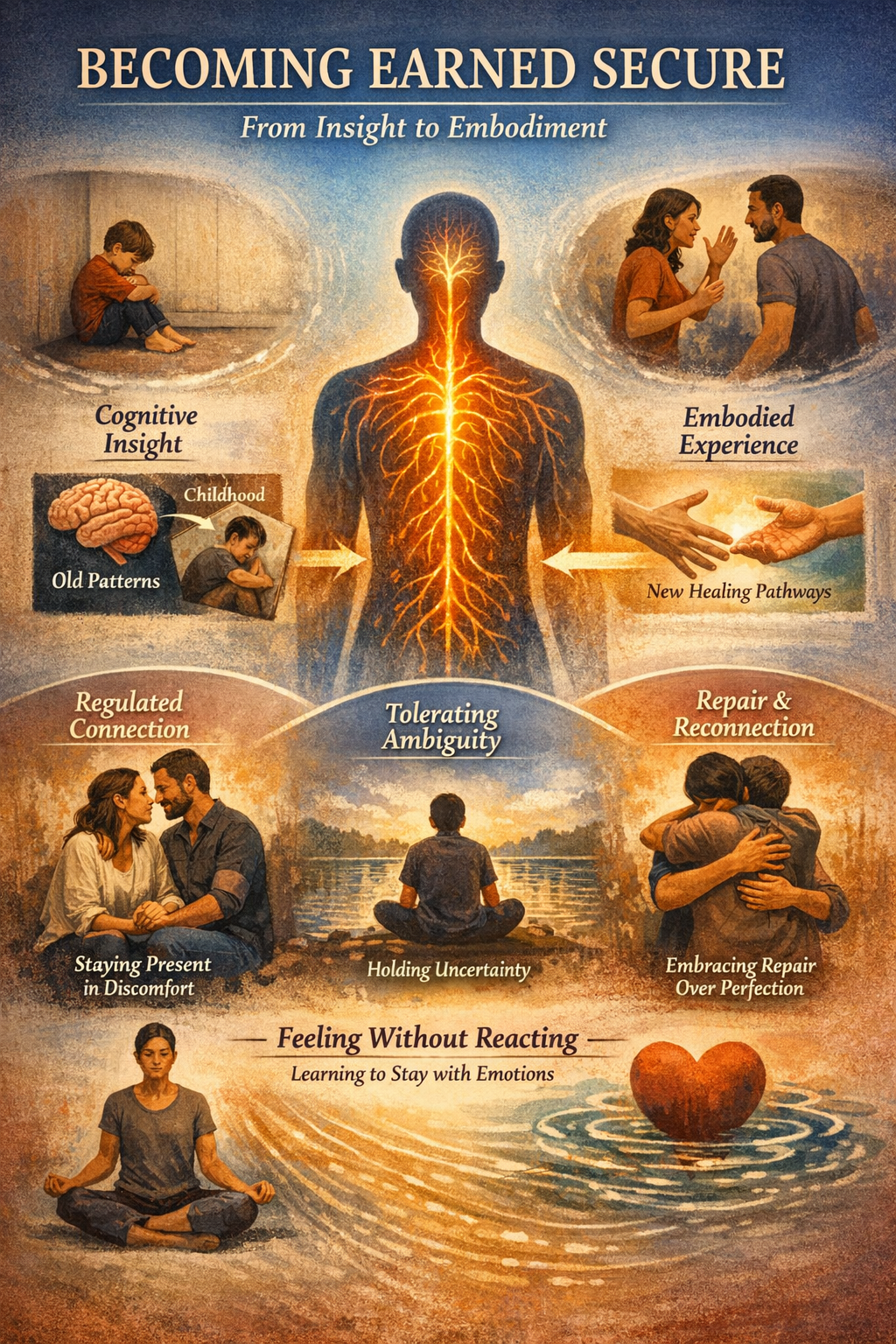
From Insight to Embodiment
Becoming earned secure is often framed as a psychological milestone: you learn about attachment theory, identify your patterns, trace them to childhood, and gradually “fix” them through insight. This framing is comforting because it suggests that understanding is enough.
But for most people, it isn’t. Insight may explain why you react the way you do, but it rarely changes that you react. The reason is simple and humbling: attachment strategies are not primarily cognitive. They are survival adaptations embedded in the nervous system.
Attachment patterns formed long before you had language for them. They emerged in the context of real or perceived threats to connection—inconsistent caregiving, emotional unavailability, intrusion, abandonment, chaos. The body learned what it needed to do to preserve proximity or minimize pain. Some bodies learned to cling, pursue, and protest. Others learned to numb, detach, and stay self-sufficient. Some learned to oscillate chaotically between the two. These strategies worked once. That is why they persist.
Because these patterns live in the body, they cannot be reasoned away. They are activated automatically, often faster than conscious thought. You may know that a delayed text does not mean abandonment, yet your chest tightens and your thoughts race. You may know that conflict does not equal danger, yet your system floods with heat and urgency. Earned security does not come from convincing yourself otherwise. It comes from giving the nervous system repeated corrective experiences.
Regulated Connection as the Core Mechanism
The primary engine of earned security is regulated connection. This means being in relationship—romantic, familial, therapeutic, or even deeply platonic—while remaining within a tolerable window of nervous system arousal. Regulation here does not mean calm at all times. It means staying present without tipping into overwhelm or shutdown.
Each time you remain engaged while discomfort is active, something subtle but profound happens. The body receives new data: I can feel this and stay connected. This is radically different from the old learning: If I feel this, something bad will happen unless I act immediately.
For the anxiously oriented, this often means resisting the urge to pursue, explain, demand reassurance, or escalate. For the avoidantly oriented, it often means resisting the urge to withdraw, minimize, intellectualize, or disappear. For those with disorganized patterns, it means staying with the confusion itself without swinging into either pole.
These moments are not dramatic breakthroughs. They are small, often unimpressive acts of staying. You feel the urge to send the extra text and don’t. You feel the urge to shut down and instead say, “I need a moment, but I’m still here.” You feel misunderstood and tolerate that gap long enough to clarify rather than attack or flee. Over time, these repetitions accumulate. The nervous system updates its expectations not through logic, but through lived evidence.
Tolerating Emotional Ambiguity
One of the least discussed but most crucial capacities in earned security is the ability to tolerate emotional ambiguity. In insecure attachment, ambiguity is not neutral—it is threatening. Not knowing where you stand, what the other person feels, or how something will resolve activates survival responses. The system demands certainty, and it demands it now.
This is why insecure patterns often involve forcing outcomes. The anxious system pushes for clarity through pursuit, questioning, or emotional escalation. The avoidant system forces clarity by disengaging: If I don’t need you, I don’t need to know. Both strategies collapse ambiguity prematurely, but at a cost. They trade long-term safety for short-term relief.
Earned security involves learning to stay with not-knowing without reflexively resolving it. This does not mean passivity or self-abandonment. It means allowing time and space for the relational field to unfold. It means trusting that clarity can emerge through contact rather than control. This is deeply counterintuitive for survival-trained systems, and it often feels like doing nothing while everything inside you screams to act.
Yet ambiguity tolerance is a cornerstone of mature intimacy. Real relationships are dynamic. Feelings fluctuate. Misunderstandings happen. People are sometimes unavailable, distracted, or imperfect. When ambiguity is no longer interpreted as imminent danger, the system relaxes. Choice returns.
Repair Over Perfection
Another defining feature of earned security is a shift in how rupture is understood. In insecure attachment, rupture is experienced as catastrophic. A misstep, a conflict, a moment of disconnection feels like proof that the relationship is unsafe or doomed. The system responds by either escalating to prevent loss or disengaging to avoid pain.
Secure attachment operates on a different assumption: rupture is inevitable. What matters is not the absence of disconnection, but the presence of repair. Repair is the process of acknowledging impact, taking responsibility where appropriate, and re-establishing connection. It requires humility, emotional literacy, and tolerance for discomfort.
Learning to repair rather than avoid rupture is one of the most powerful corrective experiences available. Each successful repair teaches the nervous system that connection can bend without breaking. That conflict does not equal abandonment. That mistakes are survivable. Over time, this erodes the hypervigilance that fuels insecure strategies.
Importantly, repair must be embodied, not performative. Apologies given to end discomfort rather than restore connection do little to rewire attachment expectations. Genuine repair involves staying emotionally present long enough for trust to be rebuilt, even when that feels vulnerable or exposing.
Feeling Without Immediately Acting
At the heart of earned security is a capacity that sounds simple but is anything but: the ability to feel sensations without immediately acting to shut them down. Grief, longing, desire, fear, jealousy—these sensations are not problems to be solved. They are signals moving through the body.
In insecure systems, sensation is often equated with danger. Feeling too much once led to loss, overwhelm, or rejection. As a result, the system learned to interrupt sensation through action: reassurance-seeking, distancing, numbing, controlling, or intellectualizing. These actions reduce discomfort quickly, which reinforces them. The nervous system learns, This worked. Do it again.
Earned security develops when sensation can be allowed to rise and fall without immediate discharge. This does not mean suppressing needs or never acting. It means delaying action long enough for regulation and choice to re-enter the picture. When sensation is no longer automatically paired with threat, it loses its urgency. Fear becomes information rather than command. Desire becomes something you can feel without grasping. Grief becomes something you can carry without collapsing.
This capacity is deeply embodied. It is cultivated through practices that increase interoceptive awareness: noticing breath, muscle tension, temperature, heartbeat. Through therapy that emphasizes present-moment experience rather than narrative alone. Through relationships where feeling does not lead to punishment or withdrawal.
From Managing Attachment to Embodying Security
Ultimately, earned security is not about managing your attachment style. It is about becoming someone whose nervous system expects connection to be safe, flexible, and repairable. This expectation is not adopted; it is learned through experience.
As security becomes embodied, several shifts occur naturally. Urgency decreases. You no longer feel compelled to secure outcomes at all costs. Boundaries become clearer, not harsher. You can tolerate others’ emotional states without absorbing or reacting to them. Intimacy becomes less performative and more real.
Perhaps most importantly, safety stops being something you chase, demand, or defend. It becomes something you carry. And from that place, relationships are no longer battlegrounds for survival, but spaces for contact, growth, and mutual influence.